
Sheila recently posted Analytics and #moocmooc in which she collects some thoughts on the role of analytics in courses and how some of the templates I’ve developed can give you an overview of what is going on. As I commented in the post I still think there is more work to make archives from event hashtags more useful even if just surfacing tweets that got most ‘reaction’.
There are three main reactions that are relatively easy to extract from twitter: retweets, favouring and replies. There are issues with what these actions actually indicate as well as the reliability of the data. For example users will use ‘favouring’ in different ways, and not everyone uses a twitter client that can or uses a reply tweet (if you start a message @reply without clicking a reply button Twitter looses the thread).
But lets ignore these issues for now and start with the hypothesis that a reaction to a tweet is worth further study. Lets also, for now, narrow down on threaded discussions. How might we do this? As mentioned in Sheila’s post we’ve been archiving #moocmooc tweets using Twitter Archiving Google Spreadsheet TAGS v3. As well as the tweet text other metadata is recorded including a tweet unique identifier and, where available the id of the tweet it is replying to.

We could just filter the spreadsheet for rows with reply ids but lets take a visual approach. Downloading the data as a Excel file we can open it using the free add-in NodeXL.
.
@mhawksey NodeXL Documentation and resources: bit.ly/P2ZVTE – Videos: bit.ly/SweSE8 – Blog: bit.ly/cgc3Qg#SNA#Docs
— Marc Smith (@marc_smith) August 24, 2012
NodeXL allows us to graph connections, in this case conversation threads. NodeXL allows use to do other useful things like group conversations together to make further analysis easier. Skipping over the detail here’s what you get if you condense 6,500 #moocmooc tweets into grouped conversations.
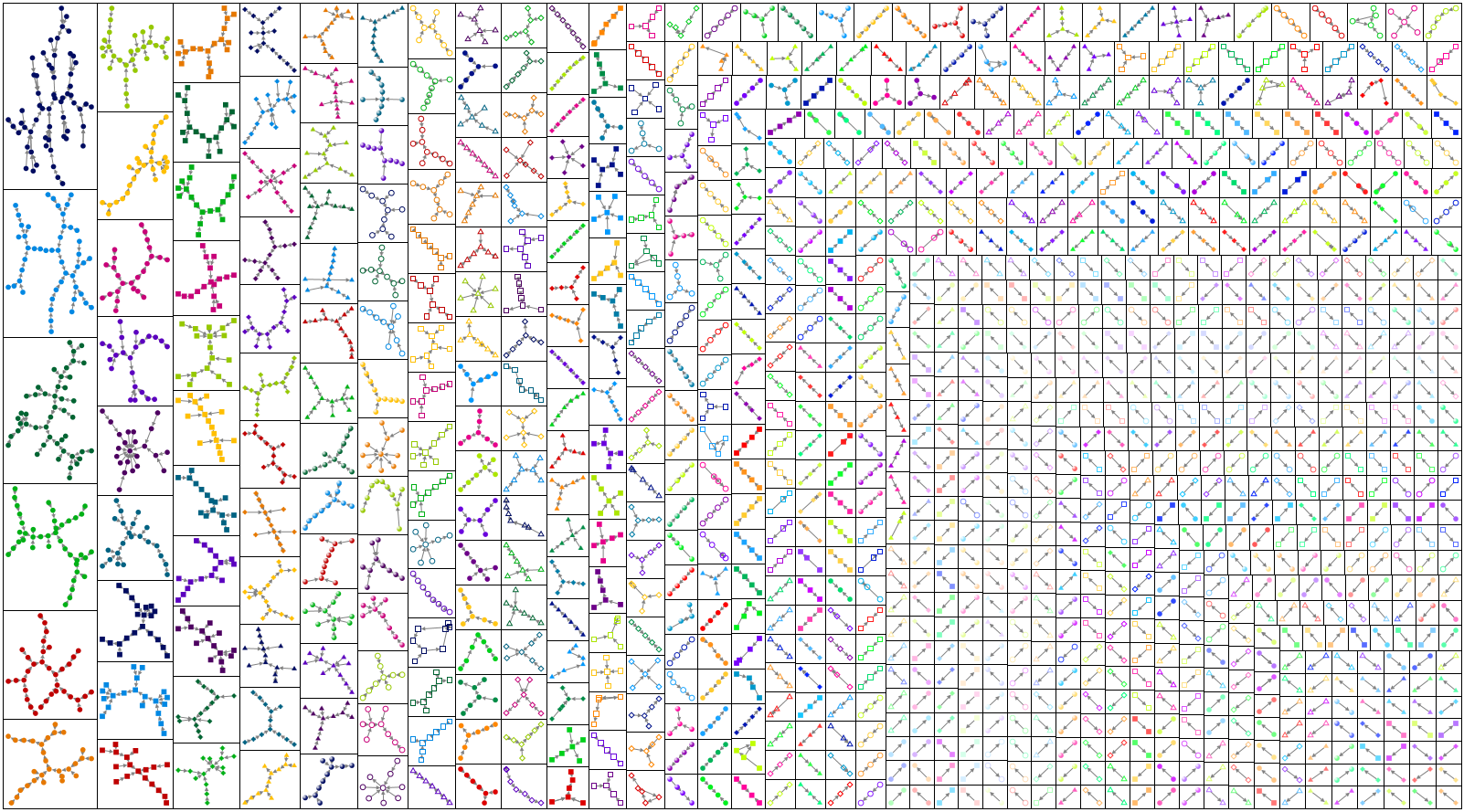
This is more than just a pretty picture. In NodeXL I’ve configured it so that when I hover over each dot which represents and individual tweet I get a summary of what was said by who and when (shown below).

It’s probably not too surprising to see strings of conversations, but by graphing what was an archive of over 6500 tweets we can start focusing on what might be interesting subsets and conversation shapes. There are some interesting patterns that emerge:


Within NodeXL I can extract these for further analysis. So the middle image can be viewed as:

There’s a lot more you can do with this type of data, start looking at how many people are involved in conversations, number of questions per conversations and lots more. I should also say before I forget that NodeXL can be configured to collect twitter search results with it’s built-in twitter search tool. It can also be configured to do the collection on a regular basis (hmm I should really have a go at doing that myself). So potentially you’ve got a nice little tool to analysis twitter conversations in real-time …
If you’d like to explore the data more it’s available from the NodeXLGraphGallery. I’m going off to play some more 😉

Lorna M. Campbell
Brilliant work Martin! Being able to analyse and view data and interactions like this opens up so many possibilities for those facilitating and participating in moocs and other large scale online events.
First look at analysing threaded Twitter discussions from large archives using NodeXL #moocmooc JISC CETIS MASHe | #MOOCMOOC | Scoop.it
[…] It’s probably not too surprising to see strings of conversations, but by graphing what was an archive of over 6500 tweets we can start focusing on what might be interesting subsets and conversation shapes. There are some interesting patterns that emerge. […]
First look at analysing threaded Twitter discussions from large archives using NodeXL #moocmooc JISC CETIS MASHe | MOOCs and Open Educational Resources | Scoop.it
[…] "It’s probably not too surprising to see strings of conversations, but by graphing what was an archive of over 6500 tweets we can start focusing on what might be interesting subsets and conversation shapes. There are some interesting patterns that emerge." Interesting visualization result – it's a good snapshot compilation of a synchronous conversation… would be interested in how the individuals featured here reacted to seeing this diagram. […]
dave cormier
uh. wow.
that is all.
Can i have one?
This is really awesome… did i mention that?
Simon Ensor
Great job just come back from learning about nodexl at #eurocall thanks to Wendy Chambers from Calgary
Sheila’s work blog » eAssessment Scotland - focus on feedback
[…] also been thinking more about the subsequent twitter analysis Martin has done of the #moocmooc twitter archive. On the one hand, I think these network maps of […]
Notes from the Twitter backchannel at eAssessment Scotland 2012 #eas12 JISC CETIS MASHe
[…] well as monitoring the number of tweets being posted during the day, following on from my work on analysing threaded Twitter discussions from large archives using NodeXL #moocmooc, I included the number threaded replies* in the archive. Of the 1,196 #eas12 tweets 10% (n.115) […]
August round-up/roundup » Danegeld
[…] the same lines, what use is a hashtag archive eh? @hawksey has been looking at surfacing tweets that get most ‘reaction’, ie RTs, faves, replies. He’s applied this to #moocmooc, which I had a quick look at but […]
‘Activity’ in the Twitter backchannel at #altc2012 day 1 JISC CETIS MASHe
[…] So I think I’m adjusting my expectation of the backchannel and taking a leaf out of Sheila MacNeill’s Confessions of a selfish conference tweeter. I still think there are opportunities unpick the discourse from Twitter communities, but just when people are in a different mode like in #moocmooc. […]
Any Questions? Filtering a Twitter hashtag community for questions and responses [situational awareness] #CFHE12 JISC CETIS MASHe
[…] required to aggregate and disseminate the course discussions?” and started looking at techniques to retrospectively analysis Twitter based discussions. This activity hasn’t gone unnoticed and I was very grateful to be asked by Dave Cormier […]
CFHE12 Week 1 Analysis: Twitter isn’t so massive JISC CETIS MASHe
[…] Extracting a conversation graph, which is shown below, there isn’t a great deal of @replies for week 1. In the graph each dot represents a single tweet and dots are joined if the person is @replying that tweet. I probably need to find a way for you to interact with this graph, but for now I’ve prepared these pages with conversations for groups G1-G4: […]
Summary of some of the monitoring tools and recipes I use at JISC CETIS JISC CETIS MASHe
[…] More info: http://mashe.hawksey.info/2012/08/first-look-at-analysing-threaded-twitter-discussions-from-large-ar… […]
Su Butcher (@SuButcher)
This is great Martin- would love to use NodeXL too for some of our discussions.
I’ve downloaded the plugin but can’t seem to work out how to add it to Excel. I’m using version 2011 for mac – so I’m going to ask on the Codeplex site as they don’t seem to have any visible information about how to install.
S
Martin Hawksey
Hi Su – unfortunately this add-in only works for the windows version. Writing a web tool to replicate what NodeXL is doing is on my ‘todo’
Martin
Su Butcher (@SuButcher)
That’s great – I knew you’d know.
I’ve got a netbook that runs Windows 7 but I can’t justify buying a whole new Office suite just for this feature – so would be very interested in your web tool when it turns up 🙂
#LAK13: Recipes in capturing and analyzing data – Twitter Jisc CETIS MASHe
[…] First look at analysing threaded Twitter discussions from large archives using NodeXL #moocmooc […]